The Forest Principle: spend intelligence on the environment, not the model
Stigmergy applied to a corpus. What a navigable environment concretely means, what it buys in tokens and hardware, and what it honestly does not fix.
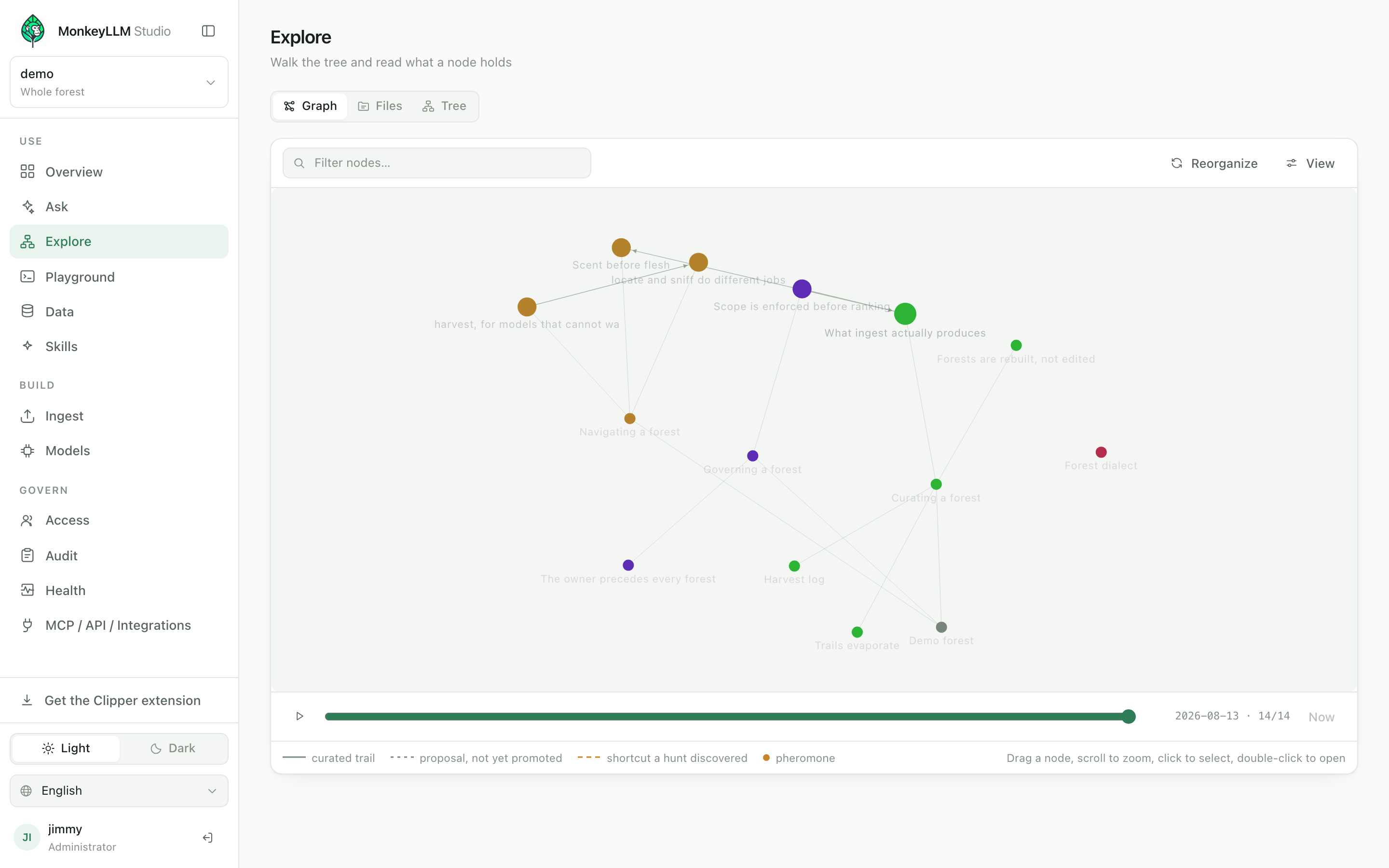
Most of the money in an AI system goes to the model. Bigger weights, longer context, more reasoning tokens, another retry. The Forest Principle proposes the opposite budget:
Spend intelligence on the environment so you can spend less on the model.
It is not a slogan about prompt engineering. It is a claim about where structure should live.
Where the idea comes from
Ants solve routing problems that no individual ant understands. They do it by modifying the terrain: a successful trip leaves pheromone, pheromone attracts more traffic, heavy traffic reinforces the trail, and unused trails fade. The intelligence is not in the ant. It is in the environment the colony has edited. Biologists call this stigmergy.
Apply that to a corpus and the design writes itself. If knowledge is stored as an undifferentiated pile of chunks, every question must be answered by raw model capability. If knowledge is stored as a navigable environment, a much smaller model can find its way.
What "an environment" concretely means
A curated passport on every node. Each node carries a short, honest summary of what it is for, written once, read every time. This is the scent an agent follows. Summaries generated at ingest time follow a contract, and compliance with that contract is measured, not assumed: the published run reports 100% conformance.
Typed edges. Parent and child, plus explicit relations between nodes that belong together. An agent moving along an edge is making a decision with a reason, not gambling on cosine similarity.
Budgeted primitives. Ten operations (locate, look, move, pick, scan, sniff, query, plant, graft, tend), each with an explicit token budget and explicit truncation. The agent always knows what it did not see, which is the difference between reasoning and hallucinating.
Pheromone. Successful hunts deposit a trace and mint shortcut links, so the paths that work get easier to find. The corpus learns from use.
What it buys
On a benchmark where every question needs at least three chained hops, the same 12B local model went from 0/11 as a classic top-k RAG reader to 11/11 as a forest navigator, at 0.58× the tokens per correct answer of an iterative-RAG baseline, on a single RTX 3090. Retrieval itself stays cheap: BM25-only entry points reach recall@5 of 1.0 at 1.3 ms p95: no embedding service in the path at all.
The trade is visible in the ingest cost: about 1.71 seconds per document to convert, summarise and commit it. You pay once, at write time, in a batch you can watch, instead of paying on every single query, forever, in tokens.
What it does not claim
A better environment does not make a small model good at everything. It makes it good at finding, which turns out to be most of what a knowledge system actually does. Reasoning over what it found still depends on the model, and a larger one still reasons better.
It also does not come free. An environment has to be maintained: the Gardener converts and summarises what arrives, the Ranger keeps the forest healthy over time, and a human still writes the one thing no machine can infer: what a dataset actually means.
The consequence for the product
If the environment is the asset, then the console is not the product. The console is a window: it is where people watch, govern and teach what the engine serves. Anything it shows, an API client holding the same key could fetch. There is no privileged path, because the value was never in the UI. It is in the forest behind it.