Ten Typed Tools over MCP
Why agents get ten small, typed, token-budgeted tools over MCP instead of one giant search box, and what that buys in tokens, latency, and legible failures.
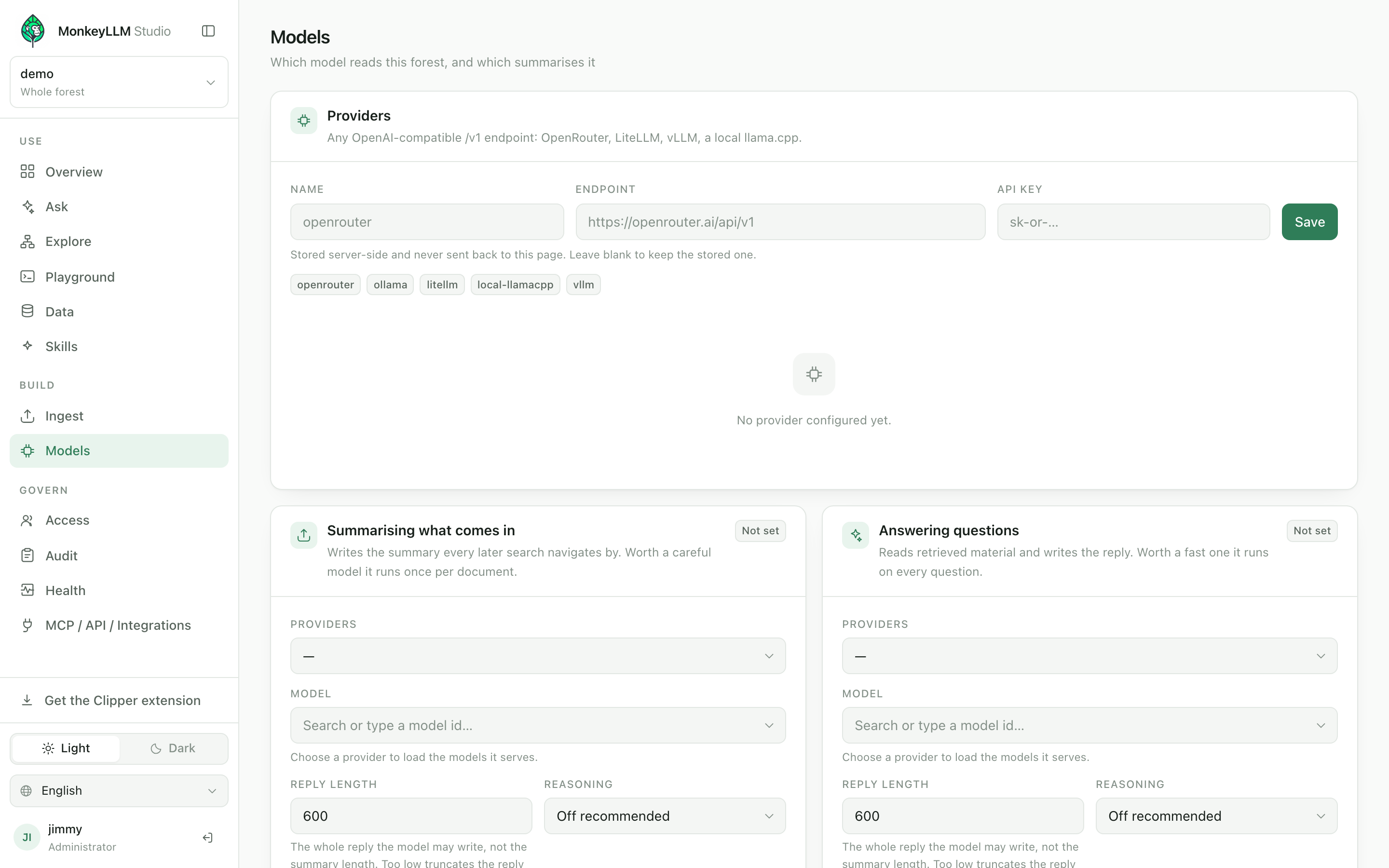
Hand an agent a single giant search tool and every problem becomes a query. MonkeyLLM hands agents ten typed tools over MCP instead: small verbs, strict schemas, and a token budget on every call. The shape of the toolbox is most of the design.
Ten verbs, three families
A MonkeyLLM forest (a self-hosted graph of curated notes, each carrying a passport: title, sixty-token summary, tags) is worked entirely through ten typed tools, and they map cleanly onto the system's three moves.
The Navigate family covers entering and walking: search for an entry point, read a node's passport, open its body, follow its links. The Plant family commits knowledge: create nodes and link them into place. The Pheromone family closes the loop: after a successful hunt, deposit a trace so the route gets marked and shortcut links get minted, the way ant trails shorten a path that keeps paying off.
They travel over MCP, the Model Context Protocol, an open standard for exposing tools to agents. That means the forest plugs into Claude Code or any MCP-capable framework without adapters.

Typed beats clever
A giant search tool takes a string and returns a wall of prose, so the model has to be clever about everything: guessing query phrasings, deduplicating results, inferring structure from text. Typed tools invert that. The schema says exactly what goes in. The result says exactly what came back: a passport is always a passport, never a surprise page dump. And the result's shape implies the legal next moves, an id you can open, links you can follow.
Two things fall out. First, modest models can drive it. On our benchmark of 11 strictly multi-hop questions, the same 12B local model scores 0/11 as a top-k RAG reader and 11/11 as a forest navigator. It did not get smarter between the columns; it got a toolbox where choosing is the only hard part. Second, failure gets legible. Every hop is a discrete, typed call, so you can see which tool, which node, which budget, and exactly where a hunt went off the trail, instead of staring at one bad blob of context.
The budget is enforced, not requested
Every one of the ten tools is token-budgeted: a call never returns more than its budget allows. Passports are cheap, bodies cost more, and the agent decides what it can afford while the environment enforces the ceiling. That is very different from a prompt politely asking the model to be concise.
The measured effect, against an iterative-RAG baseline: 0.58x tokens per correct answer, at 8.4 s p95 versus the baseline's 17.5 s. The full comparison is in agentic RAG vs budgeted navigation. The Studio's Models screen (this post's cover) is where those budgets live: model bindings, ceilings, and the answer store's running score.
Ten doors into a vault
Small typed tools are also an access-control surface you can reason about. Keys are scoped per person: one key may only navigate, another may also plant. Everything is self-hosted, the engine Apache-2.0, the apps AGPL, and the data never leaves your infra. Your forest is a vault, and the ten tools are its only doors.
Wire one up
The Integrations screen prints copy-paste snippets for your own deployment, address already filled in.
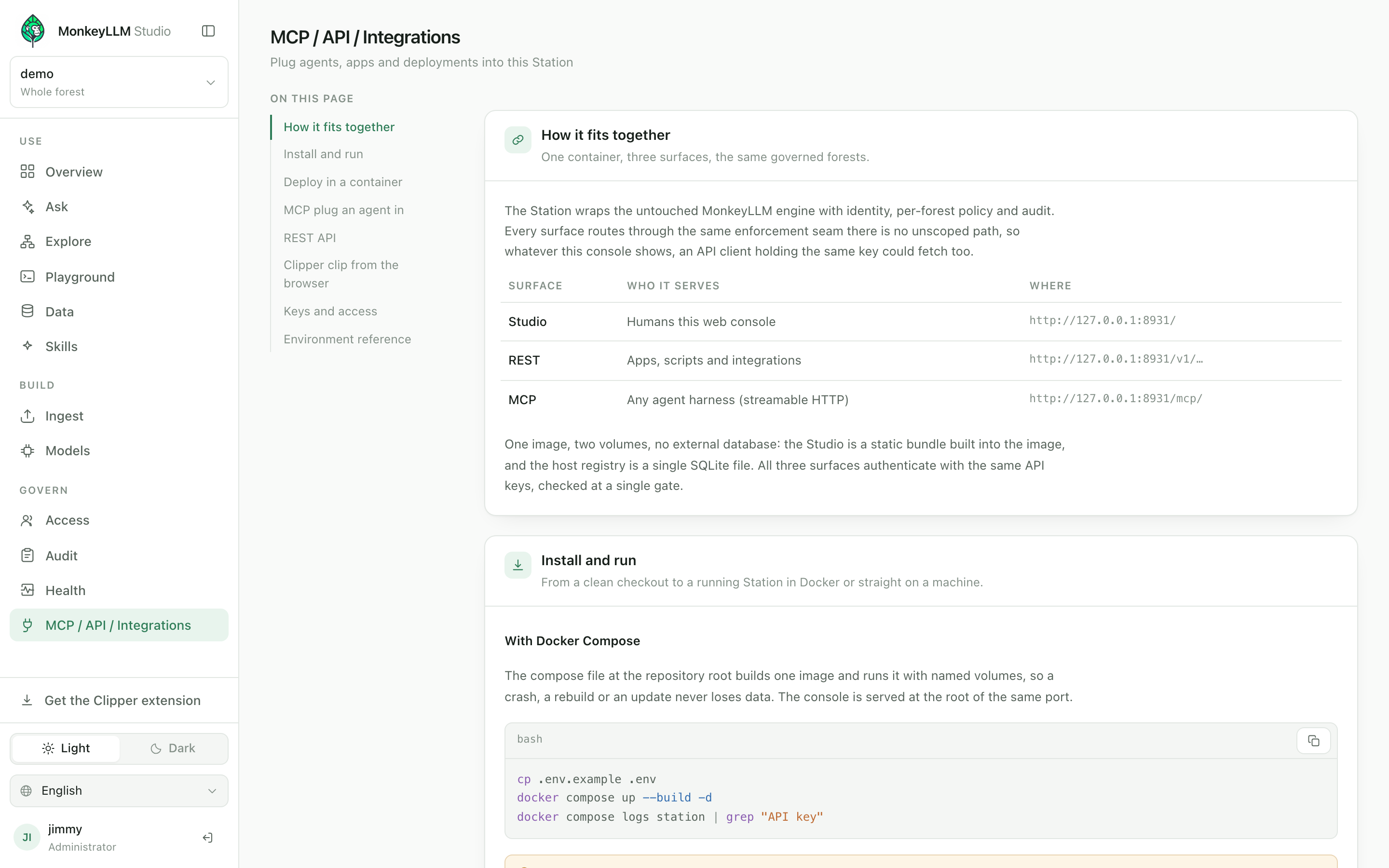
Start with the MCP docs for the protocol surface and the primitives reference for what each tool takes and returns; deploy gets you a forest in four commands. Then point an agent at https://github.com/JimmyWesley/MonkeyLLM's forest of tools and watch which ones it reaches for. Everything else is at https://monkeyllm.com.