Navigate, Don't Retrieve: What a Hunt Actually Looks Like
Three moves, one worked hunt through a small company's corpus, and why the same 12B model goes from 0/11 to 11/11 when it walks a forest instead of reading a top-k paste.
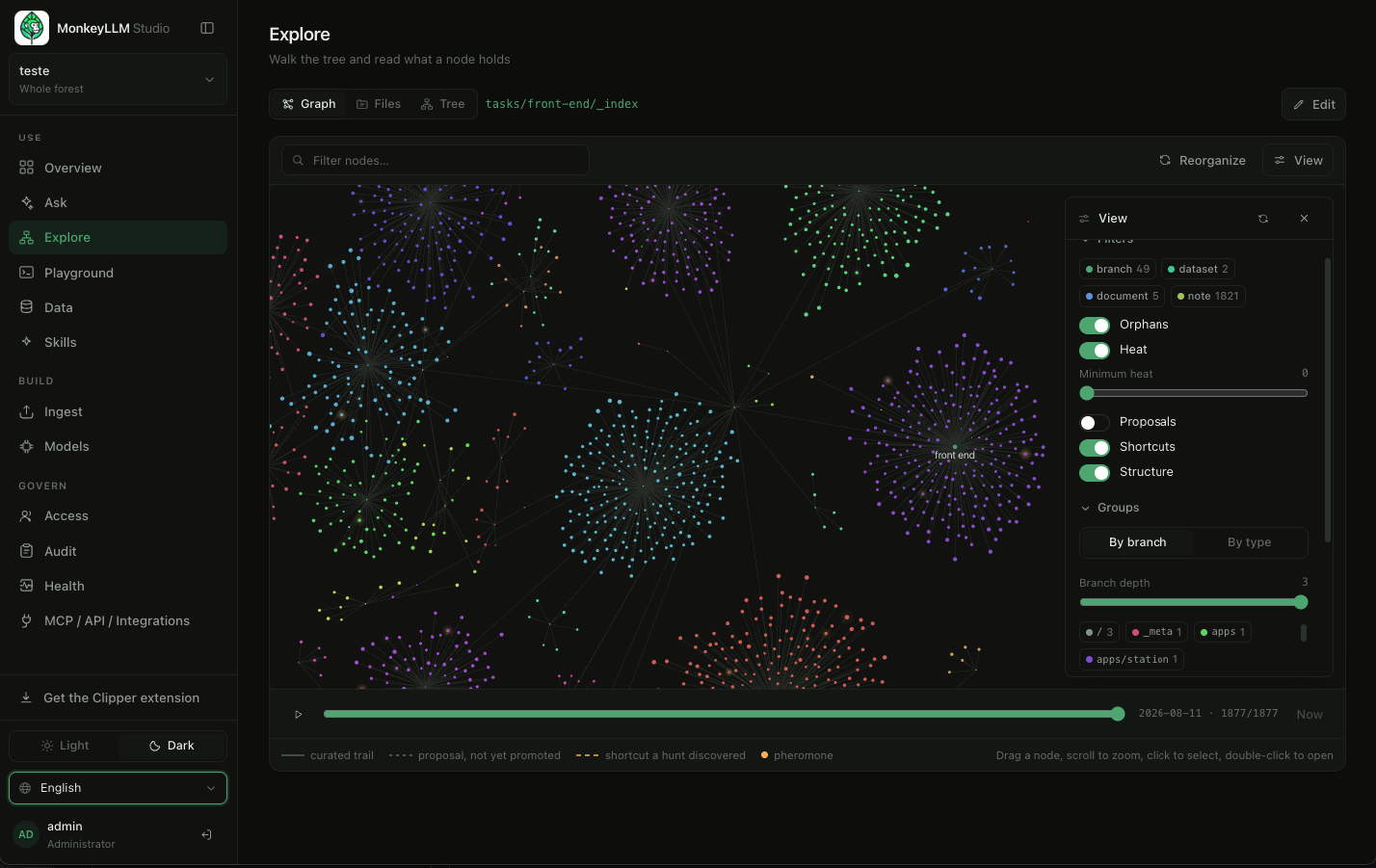
Top-k retrieval hands your model a pile of chunks and a prayer. Navigation hands your agent a map, a budget, and legs. Here is what "Navigate, don't retrieve" means once a real question hits a real corpus: the three moves, one worked hunt, and the numbers that made us commit to the slogan.
Three moves, no magic
A MonkeyLLM forest is a self-hosted graph of small, curated notes. Each node carries a passport: a title, a summary held to sixty tokens, tags, and aliases. That is the label an agent can read without paying to open the node. On top of that structure, agents make exactly three kinds of moves, exposed as typed tools over MCP:
Navigate. The agent enters through search, reads the passports around it, follows a link, and opens only what it needs. It walks the graph the way you walk a wiki when you are in a hurry: read the label, decide, click.
Plant. New knowledge is committed as new nodes, passport and links included, so the forest grows instead of going stale.
Pheromone. Successful hunts deposit traces and mint shortcut links. In plain English: routes that produced correct answers get marked, like ant trails, so the same class of question costs fewer hops next time.
Every hop is token-budgeted. The agent never receives more than a passport unless it explicitly opens a node, and each opening is charged against a budget the environment enforces.
A worked hunt
Take a plausible everyday corpus: the operational knowledge of a forty-person company. Runbooks, postmortems, vendor contracts, onboarding notes, a compliance calendar. A few hundred nodes once planted.
The question: why do staging deploys pause on the first Monday of every month?
The agent searches "staging deploy pause" and enters at the Staging Deploy Runbook node. Its passport says it owns the deploy schedule and links out to a Change Freeze Policy. The agent opens the policy: freezes are tied to audit and close windows, with a link to the Compliance Calendar. One more hop: the calendar says SOC 2 evidence collection runs on the first Monday of each month, and deploys freeze while it runs. The agent answers, citing the three nodes it stood on.
Total cost: a dozen passports skimmed, three nodes opened, a few hundred tokens each.
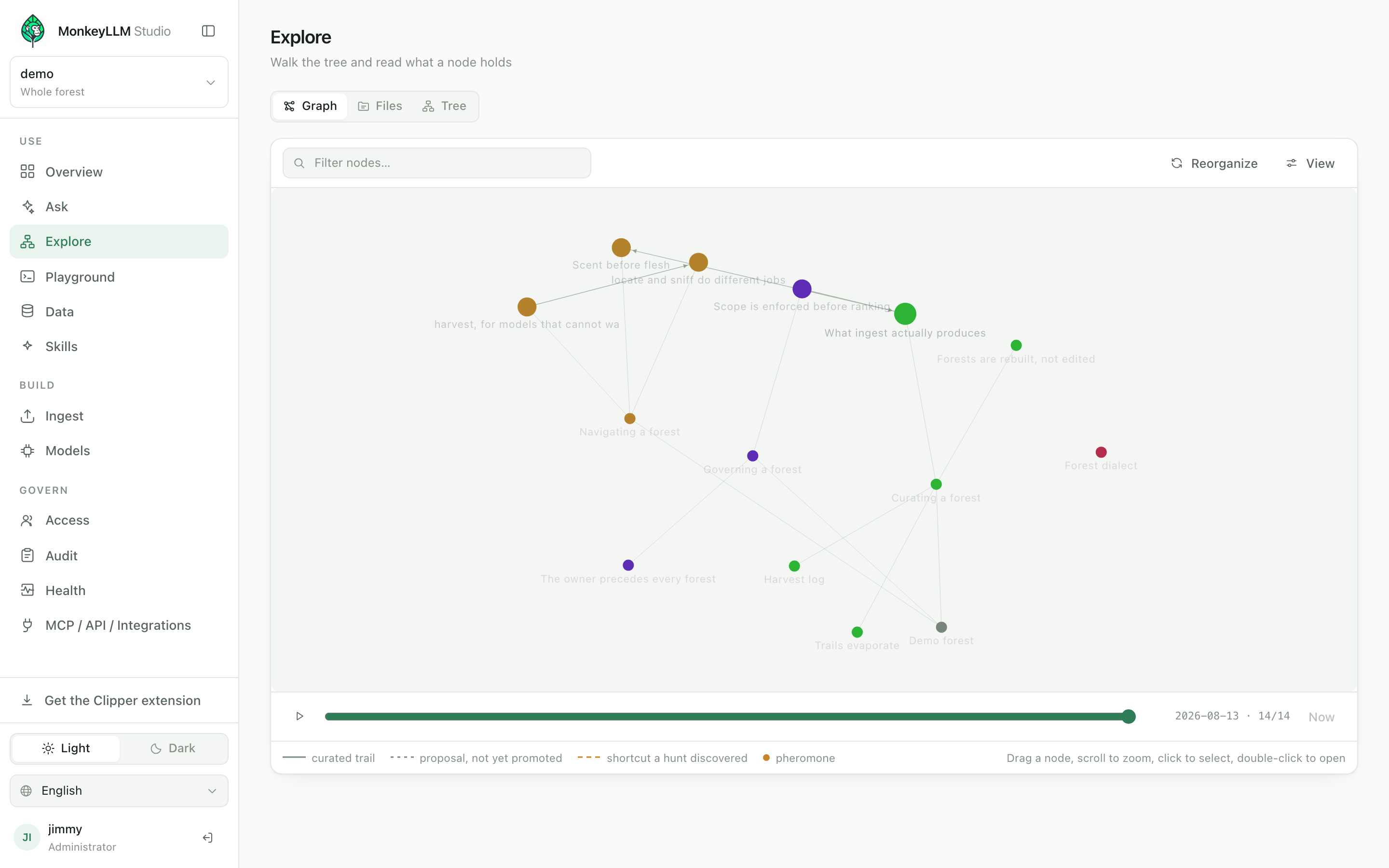
Now aim classic top-k retrieval at the same question. "Staging", "deploy", and "Monday" light up the runbook and a couple of postmortems, while the compliance calendar shares almost no vocabulary with the query, so it never reaches the context window. The connecting fact lives in the links between documents, and links are exactly what a flat chunk store throws away. We unpack that failure mode in why multi-hop breaks RAG: top-k is a single hop by construction, no matter how large the k.
The numbers behind the slogan
We benchmarked this with 11 strictly multi-hop questions, each needing at least 3 chained hops. The same 12B local model scores 0/11 as a classic top-k RAG reader and 11/11 as a forest navigator.
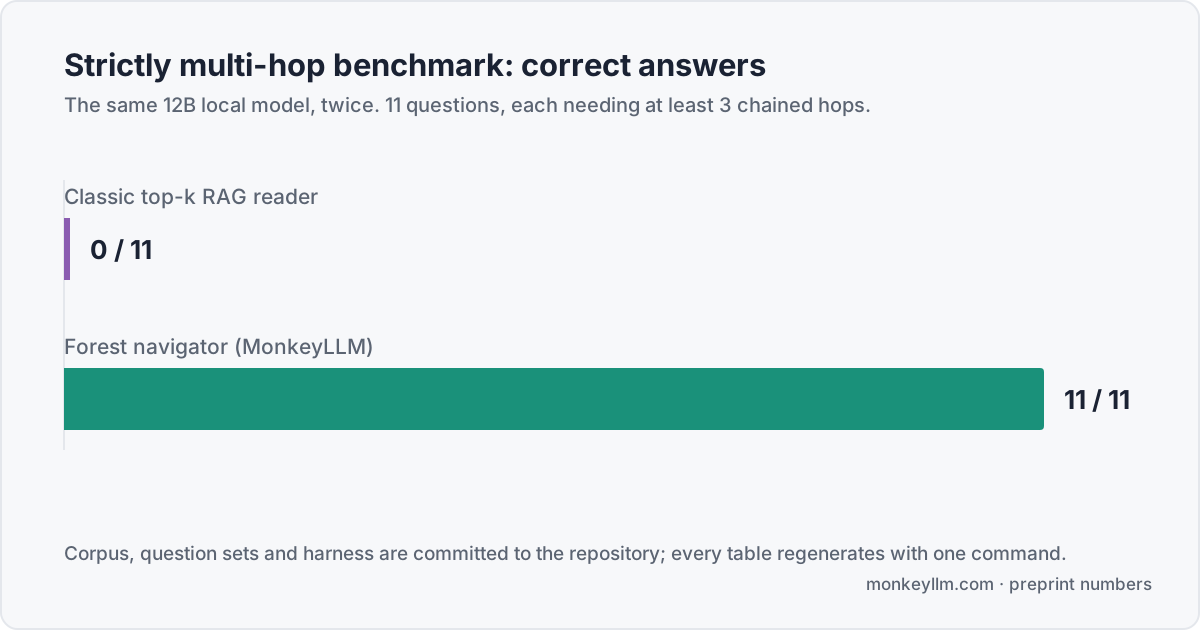
The model did not change between the columns. The environment did. That is the bet the whole system makes, and the longer argument is the Forest Principle.
Honesty, because slogans invite skepticism: 11 questions is small and we say so. The corpus, the question sets, and the harness are committed, every table regenerates with one command, and the report keeps a criterion we failed right next to the ones we passed.
Start walking
All of the above runs on a single RTX 3060 with 12 GB; a quantized 12B fits it whole, and 8 GB cards work with tighter quantization or by pointing the chat binding at any OpenAI-compatible endpoint. The engine is Apache-2.0 and a forest deploys in four commands: start with the quickstart or the Docker walkthrough.
Star the project at https://github.com/JimmyWesley/MonkeyLLM, or better, reproduce the 0/11 to 11/11 table yourself. Everything you need is at https://monkeyllm.com.